Monday, 26 February 2018

Week 9 - Digital - Personal Learning Networks and Consecutiveness 29 January 2018

Before Class
After reading the required article 'Connectivism: A Learning Theory for the Digital Age', fill out the following form with your responses to check your understanding of some of the key ideas within it. 
Connecting and Collaborating
When we talk about digital and collaborative learning as the two main concepts behind the postgraduate programme, this linking of digital tools and collaboration acknowledges the critical role of information and communication technologies in enabling contemporary forms of collaboration. "The learners in the digital age are able to connect and collaborate with people beyond their physical environment. They can connect a range of information or data and draw on a range of perspectives to collaboratively generate and critique new ideas." (Starkey, 2012).
Personal Learning Networks (PLNs) and Environments (PLEs)
A personal learning network is an informal learning network that consists of those people who a learner interacts with and derives knowledge from. These may be people known personally, but equally they may be people who are only connected via the Web, and there may be no personal interaction, simply an exchange of learning. The term 'personal learning environment' (PLE) is sometimes used in conjunction with PLNs, but focuses more on the toolset that learners use in order to implement their learning networks. In essence, it is possible to have a personal learning network that is entirely face to face (though this would be rather limiting). In contrast a PLE assumes a digital toolset that will support the interactive learning process (EDUCAUSE, 2009).
Connectivism 
There are several principles of the theory of connectivism, as outlined by George Siemens in 2004, in his article “Connectivism: A learning theory for the digital age” (Siemens, 2004). Siemens has also pioneered the types of online course that have been labelled 'MOOCs' (Massive Open Online Courses). Stephen Downes, who has worked with Siemens on these courses, emphasises that their style of MOOC is connectivist (cMOOC), while other types of MOOC use more conventional approaches. Downes has collected his extensive writing on connectivism into an online book (Downes, 2012).
Principles of Connectivism
Siemens (2004) summarises the eight principles of connectivism as:
  1. Learning and knowledge rests in diversity of opinions.
  2. Learning is a process of connecting specialized nodes or information sources.
  3. Learning may reside in non-human appliances.
  4. Capacity to know more is more critical than what is currently known
  5. Nurturing and maintaining connections is needed to facilitate continual learning.
  6. Ability to see connections between fields, ideas, and concepts is a core skill.
  7. Currency (accurate, up-to-date knowledge) is the intent of all connectivist learning activities.
  8. Decision-making is itself a learning process. Choosing what to learn and the meaning of incoming information is seen through the lens of a shifting reality. While there is a right answer now, it may be wrong tomorrow due to alterations in the information climate affecting the decision.
References:
Downes, S. (2012). Connectivism and Connective Knowledge: Essays on meaning and learning networks. Retrieved from http://www.downes.ca/files/books/Connective_Knowledge-19May2012.pdf
EDUCAUSE. (2009). 7 things you should know about Personal Learning Environments. Retrieved from https://net.educause.edu/ir/library/pdf/eli7049.pdf
Siemens, G. (2004). Connectivism: A Learning Theory for the Digital Age. eLearnSpace. Retrieved from http://www.elearnspace.org/Articles/connectivism.htm
Starkey, L. (2012). Teaching and Learning in the Digital Age. Abingdon, Oxon: Routledge

Week 9 - Leadership - Leading Change 29 January 2018

Management or Leadership?
The simple insight that management is not leadership is better understood today, but not nearly as well as is needed. Management makes a system work. It helps you do what you know how to do. Leadership builds systems or transforms old 
School Vision Statements  
Prior to the class, please bring your own school vision statement and post it in the relevant padlet for your location.
Kotter's 8 step Process
Kotter (1996) suggests that there is an 8 step process for leading change.
  1. Create a sense of urgency (identify crises and opportunities)
  2. Build a guiding team
  3. Develop a vision and strategy
  4. Communicate the vision
  5. Enable action by removing barriers
  6. Creating and celebrating short term wins
  7. Sustain change by building on gains
  8. Embed the change in culture
There is a useful diagram that summarises Kotter's process:
In reality, even successful change efforts are messy and full of surprises. But just as a relatively simple vision is needed to guide people through a major change, so a vision of the change process can reduce the error rate. And fewer errors can spell the difference between success and failure (Kotter, 1995).
Coherence
Effective leadership, rather than focusing primarily on a specific aspect of change, focuses on creating the conditions in which everyone in the group is able to envision and enact cohesion:
“Coherence consists of the shared depth of understanding about the purpose and nature of the work” (Fullan & Quinn, 2016, p.1). 
In challenging situations, people are motivated primarily by intrinsic factors: having a sense of purpose, solving difficult problems, and working with peers on issues that are of critical importance to the group (Fullan & Quinn, 2016, p.4).
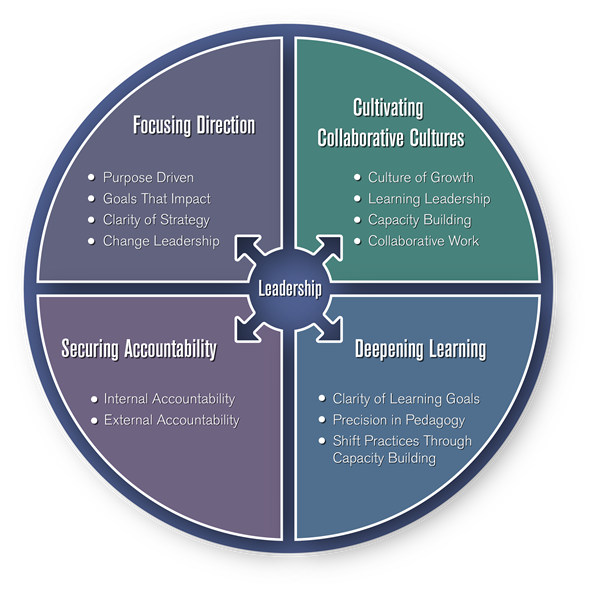
Fullan & Quinn identify the elements contained in the diagram below (from Michael Fullen's website)  as the ‘right drivers to bring about system change’ - as opposed to the ‘wrong drivers’ (such as rewarding individual teachers, national standards). 
Coherence-Framework-Extended.png
Why are these wrong drivers still being implemented? Here are some of their suggestions:
Our wrong driver analysis showed how politicians were making matters worse by imposing solutions that were crude and demotivating for the very people who have to help lead the solution … You might ask why politicians endorse solutions that don’t work. The answer is not complicated: because they can legislate them; because they are in a hurry; because the remedies can be made to appeal superficially to the public; because (and unkindly on our part) some of them really don’t care about the public education system, preferring that education to be taken over by the private sector; and (more kindly) because they do not know what else to do (Fullan & Quinn, 2016, p. 3).
Simplexity means that you take a difficult problem and identify a small number of key factors (about four to six) – this is the simple part. And then you make these factors gel under the reality of action with its pressures, politics, and personalities in the situation – this is the complex part (Fullan & Quinn, 2016, p. 127).
Leaders build coherence when they combine the four components of our Coherence Framework to meet the varied needs of the complex organizations they lead. Coherence making is a forever job because people come and go, and the situational dynamics are always in flux …The main threat to coherence is turnover at the top with new leaders who come in with their own agenda. It is not turnover per se that is the problem, but rather discontinuity of direction (Fullan & Quinn, 2016, p.128).
Change Management Toolkit
This week one of our resources (in the portal) comes from the New Zealand Post Primary Teachers' Association / Te Wehengarua (PPTA). Their Education Change Management Toolkit has been developed to assist schools in implementing effective change for improvement, following identified best practices for educational change.
The toolkit contains general principles for implementing successful education change in schools and a series of questions to answer before, during and after a change is trialled and includes a draft policy which branches can discuss with their boards.
See the following web page for more information and a link to the full document (which is also in this week's media): http://ppta.org.nz/resources/publication-list/2460...
Teaching, Designing and Developing Digital Outcomes
New digital curriculum document tinyurl.com/digitalcur
Kotter's model of change tinyurl.com/TMLKotter

References
Fullan, M. & Miles, M. (1992). Getting reform right: what works and what doesn't. Phi Delta Kappan73(10), 745-752.
Fullan, M. & Quinn, J. (2016). Coherence: The Right Drivers in Action for Schools, Districts, and Systems. Thousand Oaks: Corwin. 
Kotter, J. (1995). Leading Change: Why Transformation Efforts Fail. Harvard Business Review. March-April 1995, 59-67.
Kotter, J. (1996). Leading Change. Boston, Mass.: Harvard Business Review Press.
Maeroff, G. (1993). Building teams to rebuild schools. Phi Delta Kappan, 74(7), 512-519.
OnGuard. (2016). 8 steps to managing change. Retrieved from: http://onguard.com/process/8-steps-managing-change/
Senge, P. (1990). The fifth discipline: the art and practice of the learning organization. New York: Currency Doubleday. 

Week 8 - Digital - Design Thinking in the Classroom 22 January 2018

Design thinking by TMLU
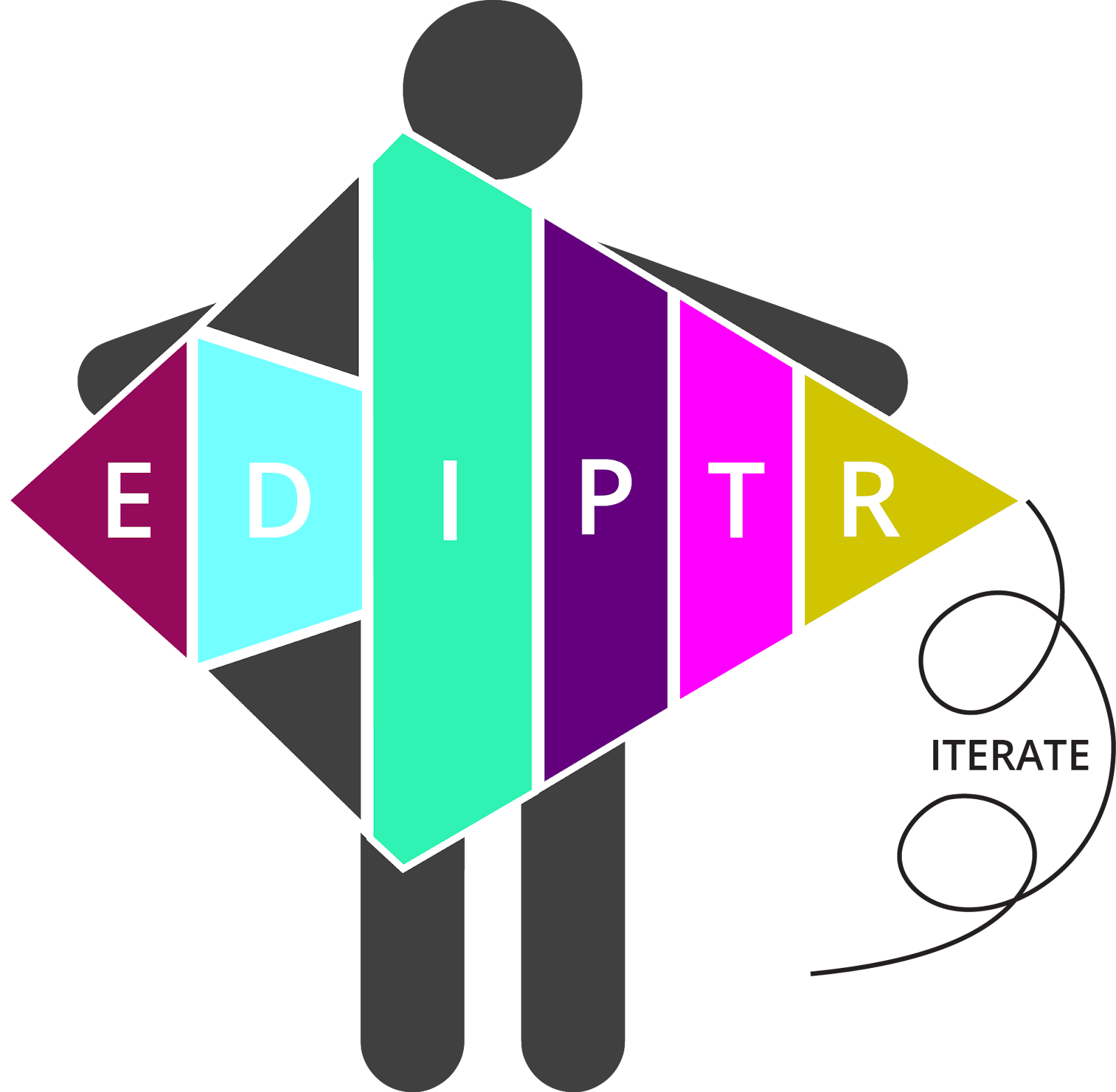
In this week's session we'll try out The Mind Lab by Unitec Design Thinking Process + materials, which uses our 'kite' model
  • Empathise
  • Define
  • Ideate
  • Prototype
  • Test
  • Reflect
Change by Design
Tim Brown, the current CEO of IDEO, has written the book about Change by Design (2009). According to him, Design Thinking is Human-centered: ‘The basic problem is that people are so ingenious at adapting to inconvenient situations that they are often not even aware that they are doing so. Our real goal is helping people to articulate the latent needs they may not even know they have’. 
Observation is important too: ´When we observe people going about their daily lives, what is it that they don’t do or don’t say?´ as well as empathy, or as Brown calls it: 'Standing in the shoes of others'. Brown talks a lot about the importance of prototyping, because: ‘Like every other kid, I was thinking with my hands…’. If you want to hear him talking about his book, we recommend you listening to this radio show.
Making ideas tangible always facilitates communication
According to Brown 'Prototypes don’t have to be expensive or time-consuming. In fact, the opposite is better: Put as little time and effort into prototypes as you can and still generate useful feedback and drive an idea forward.'
(Re)capture the Creativity of your Childhood
de Saint-Exupéry (1943) wrote a story about The Little Prince where he tried to showcase that as we age, how we see the world changes. It is the rare person who is able to hold on to the sense of wonderment, of presence, creativity, or of sheer enjoyment of life and its possibilities that is so apparent in our younger selves. As we age, we gain experience and we become better able to exercise self-control. We become more in command of our faculties, our thoughts, our desires. But somehow, we lose sight of the effortless ability to take in the world in full. The very experience that helps us become successful threatens to limit our imagination and our sense of the possible. When did experience ever limit the fantasy of a child? 
One part of the story of Little Prince also relates to customer communication, and to latent needs. At one point, the little prince is asked by a boy to draw a picture of a sheep. After several attempts that fail to meet with approval, the little prince just draws a box with holes in it:
"‘This is only his box. The sheep you asked for is inside.’ I was very surprised to see a light break over the face of my young judge: ‘That is exactly the way I wanted it!’".
Like the little prince, you don't know what your or your customers want and neither do they - until you show it to them.
Teaching Practices that encourage Design Thinking
Immersion: Have students work together in small collaborative groups to do a deep dive into the subject/topic area. Ask the students to undertake research, observation and develop questionnaires or evaluate data to gain a technical, personal and community views on a topic.
Inquiry-based Feedback: Instead of value-based feedback, inquiry based feedback coupled with observation encourages a more open-ended and in-depth approach to learning. Students are encouraged to minimise expressing their likes and dislikes, and encouraged to first spend time silently observing, and then asking questions prefixed by phrases such as "I noticed that...," "why," and "how."
Before this process begins ensure students brainstorm ways to gather information. For example:
  • Research that includes eBooks, case studies, experiments, data, academic papers etc
  • Observation that includes personal viewing, filming, online videos, documentaries, recorded interviews
  • Questionnaires that includes personal questionnaires, online surveys, research and data including census, government agency information, non-government organisation data, OECD reports etc.
Synthesis: Have students deduce interesting gaps to explore, problems to solve or opportunities to solve, using the information they have gathered from their immersion process.
Ideas on how to gain a new perspective
  • Put visuals on the wall which relate to the topic but at the fringes of the core subject.
  • Ask new questions. Create a how, when, why, what, who question and define the answers.
Note: Ask "thinking" questions – don’t make suggestions. Instead of asking questions to which there is a correct answer, ask students to create the problem. For example instead of saying"Does your girl need ears?" A thinking question would be, "What kind of music does your girl like to listen to? How can she hear the music?"
Students should pose their problem by first tapping into their own wishes and goals that might have real-life results or be largely theoretical and in end in the modeling stages. Such questions such as "How can we grow vegetables without using pesticides?" And, "How can we feed the world's population in a sustainable way?" Both encourage students to think divergently.
Questions, not suggestions, allow personal ownership based on observing, on experiences and on the imagination.
Zoom out: Put the subject/topic in the centre of focus and scale out to the next logical layer. For example if the topic was endangered tigers of India, scale back and look at the life of poachers, the local communities, the black market skin/medicine customers etc. Explore each logical layer of influence as you scale back from the heart of the topic to develop a macro view of the subject.
Ideation, Prototyping and Feedback: Have your students test ideas, solve a problem and extend their understanding without focusing on the ‘right’ answer. This part of the Design Thinking process helps students to 'hold their ideas lightly' in order to review and gain feedback from other student groups and their teacher/s.
The emphasis is on thinking skills and mindsets that allow students to create early and often, adjusting the course of their learning and applying an iterative approach to outcomes that is tweaked from the input of feedback.
Note: Nurture a culture of divergent thinking. Encourage students to be choice makers. Ask students ‘what their work needs’. If a student asks for help, assist by asking the child to give several of their ideas to discuss.
Implementation or Display: As ideas and defined the Design Thinking process moves to the celebration stage where concepts are shared. In this stage have students talk to the group about the changes they applied in their approach, what they reflected on, what evidence they found to support their findings and what new knowledge they gained or shared.
Useful resources
This free 'Design Thinking for Educators' toolkit, created by IDEO, contains the process and methods of design along with the Designer’s Workbook, adapted specifically for the context of K-12 education. It offers new ways to be intentional and collaborative when designing, and empowers educators to create impactful solutions. 
IDEO has also published a free  Field Guide to Human-Centered Design reveals their process with the key mindsets that underpin how and why they think about design for the social sector, it has 57 clear-to-use design methods for new and experienced practitioners, and from-the-field case studies of human-centered design in action.
Stanford University Institute of Design has created many useful resources, such as the Design thinking for teachers The K12 Lab Wiki and Design Thinking Crash Course that helps you to run or participate in a 90 minutes long design cycle by redesigning a Gift-Giving Project. 
For you personal interest (LEADERSHIP 2), you might want to view the curriculum for the 6-week Design Kit: The Course for Human-Centered Design -coursethat will introduce you to the concepts of human-centered design and how this approach can be used to create innovative, effective, and sustainable solutions for social change.
Eco-innovators have also developed a range of educational resources for use in and outside of the classroom, these ones are though not free.
References
de Saint-Exupéry, A. (1943). The Little Prince. Retrieved from www.odaha.com/antoine-de-saint-exupery/maly-princ/...
Brown, T. (2009). Change by Design – How Design Thinking Transforms Organization and Inspires Innovation. Harper Collins, USA

Week 8 - Leadership - Diffusion of Innovations and Digital Leadership 22 January 2018

Rogers’ adoption of Innovation Adoption Lifecycle
Potential adopters have been determined to have traits that affect their likelihood to adopt an innovation. Many individual personality traits have been explored for their impacts on adoption, but with little agreement. Ability and motivation, which vary between situations (unlike personality traits), have a large impact on a potential adopter's likelihood to adopt an innovation. Unsurprisingly, potential adopters who are motivated to adopt an innovation are likely to make the adjustments needed to adopt it.
Rogers outlines several strategies in order to help an innovation reach this stage, including when an innovation is adopted by a highly respected individual within a social network and creating an instinctive desire for a specific innovation. Another strategy includes injecting an innovation into a group of individuals who would readily use that technology, as well as providing positive reactions and benefits for early adopters.
Innovators, Early Adopters and Early Majority
According to Rogers (2002), whereas innovators are cosmopolites, early adopters are localites. This adopter category, more than any other, has the highest degree of opinion leadership in most systems. Potential adopters look to early adopters for advice and information about an innovation.
Robinson (2009) has summarised Rogers' ideas in of the Diffusion of Innovations and he suggests that when working with early adopters one should
  • Offer strong face-to-face support for a limited number of early adopters to trial the new idea.
  • Study the trials carefully to discover how to make the idea more convenient, low cost and marketable.
  • Reward their egos e.g. with media coverage.
  • Promote them as fashion leaders (beginning with the cultish end of the media market).
  • Recruit and train some as peer educators.
  • Maintain relationships with regular feedback.
Robinson describes the early majority as pragmatists, comfortable with moderately progressive ideas, but won’t act without solid proof of benefits. They are followers who are influenced by mainstream fashions and wary of fads. Majorities are cost sensitive and risk averse. They are looking for simple, proven, better ways of doing what they already do. They require guaranteed off-the-shelf performance, minimum disruption, minimum commitment of time, minimum learning, and either cost neutrality or rapid payback periods and they hate complexity.
Design Thinking in Leadership
Design Thinking argues very convincingly that we would need to provide more time for the discovery, interpretation, ideation, experimentation and evolution of ideas, both for students and for teachers. 
Instead of looking at what assets a company has to create a product, leaders who use design thinking first ask what their clients require and then identify how the organisation can fulfill those needs. Research, interviews and first-person observation identify problems that need solving, which in turn inform the products and services a company develops using creative thinking and diverse perspectives. For learning, design thinking could apply to how programs and learning tasks are developed and delivered. We shouldn't just teach design thinking to our students, but we should use it to create our projects and learning tasks.
This approach is said to help leaders by removing the taboo of creativity. According to Dr Jeffrey Sanchez-Burks, Design Thinking shrinks innovation to something that doesn’t require a massive strategic change in an organization, but can be applied every day; from how might we better communicate within a team to how might we increase our ability to identify new learning potentials and trends.
Organisational Focus on Design
Keep in mind that design thinking doesn’t solve all problems. As Kolko (2015) suggests, it helps people and organizations cut through complexity. It’s great for innovation. It works extremely well for imagining the future. An organisational focus on design offers unique opportunities for humanizing technology and for developing emotionally resonant products and services. Adopting this perspective isn’t easy. But doing so helps create a workplace where people want to be, one that responds quickly to changing business dynamics and empowers individual contributors. And because design is empathetic, it implicitly drives a more thoughtful, human approach to business.
'How Might We'? 
According to IDEO (http://www.designkit.org/) every problem is an opportunity for design. By framing your challenge as a How Might We question, you’ll set yourself up for an innovative solution.
  • Start by looking at the insight statements that you’ve created. Try rephrasing them as questions by adding “How might we” at the beginning. 
  • The goal is to find opportunities for design, so if your insights suggest several How Might We questions that’s great. 
  • Then take a look at your How Might We question and ask yourself if it allows for a variety of solutions. If it doesn’t, broaden it. Your How Might Weshould generate a number of possible answers and will become a launchpad for your Brainstorms. 
  • Finally, make sure that your How Might We’s aren’t too broad. It’s a tricky process but a good How Might We should give you both a narrow enough frame to let you know where to start your Brainstorm, but also enough breadth to give you room to explore wild ideas.
Design Thinking Mindsets
Human-centered design is as much about your head as your hands. IDEO suggests that how you think about design directly affects whether you'll arrive at innovative, impactful solutions. These 7 Mindsets explore and uncover the philosophy behind Design Kit’s approach to creative problem solving.
  • Learn from Failure
  • Make it
  • Creative Confidence
  • Empathy
  • Embrace ambiguity
  • Optimism
  • Iterate, iterate, iterate
Design Thinking in the Context of the LEADERSHIP 2 Assessment
Why and how you could use these mindsets better as a leader? In the context of your LEADERSHIP 2 Assessment think about whether it could it be part of the change initiative? Could it help you to develop it? Or would it be part of the methodology or mindset behind your leadership? Or the processes you choose to use? You choose if it is.
Stakeholder Groups
Identify your main stakeholders. Analyse which ones are relevant for this change initiative. How do you consciously identify your early adopters? Who do you need to lead (in different stakeholder groups) so that they and others will follow? Mainly focus on profiling your early adopters and early majority within the main stakeholder groups and how you’ll lead them.
Dream big - Start small. Set yourself up for success! 
Four principles to Design Thinking (Plattner, Meinel & Leifer, 2010)
  1. The human rule – all design activity is ultimately social in nature
  2. The ambiguity rule – design thinkers must preserve ambiguity
  3. The re-design rule – all design is re-design
  4. The tangibility rule – making ideas tangible always facilitates communication
Lean leadership plan?
When planning for the leadership of a change initiative in your LEADERSHIP 2 assessment, focus on planning how you’ll lead the early adopters and subsequent followers. You might include aspects that consciously eliminate ‘muda’ (waste). 
References and possible resources
Fullan, M. (2001). Leading in a Culture of Change. Wiley & Sons.
Harris, A., Jones, M. & and Baba, S. (2013). Distributed leadership and digital collaborative learning: A synergistic relationship? British Journal of Educational Technology 44(6), 926-939
Kolko, J. (2015). Design thinking comes of age: The approach, once used primarily in product design, is now infusing corporate culture. Harvard Business Review, 93(9), 66. Retrieved from https://hbr.org/2015/09/design-thinking-comes-of-age
Nichols, J. (2010). Teachers as Servant Leaders. Rowman & Littlefield.
Papa, R., Mullen, C. & Creighton, T. (2012). Educational Leadership at 2050: Conjectures, Challenges, and Promises. R&L Education.
Plattner, H., Meinel, C., & Leifer, L. (Eds.). (2010). Design thinking: Understand–improve–apply. Springer Science & Business Media.
Robinson, L. (2009). A summary of Diffusion of Innovations. Changeology. Retrieved from http://www.enablingchange.com.au/Summary_Diffusion...
Robinson, V. (2011). Student-Centered Leadership. Wiley.
Rogers, E. (2002). Diffusion of preventive innovations. Addictive Behaviors, 27(6), 989-993.
Schleicher, A. (2012). Preparing Teachers and Developing School Leaders for the 21st Century: Lessons from around the World. OECD Publishing.
Whitaker, T. (2013). Leading School Change: 9 Strategies To Bring Everybody On Board. Taylor and Francis.

week 7 - Digital - Blended Learning - 15 January 2018

Flipped preparation link
Log in as a student to EDpuzzle by using this link . Join with your preferred Google account. Remember that we want you to use EDpuzzle as a student, so don't log in as a teacher. That link will direct you to the right class page so that you can view the assigned homework.
Blended Learning
The definition of blended learning is a formal education program in which a student learns: (1) at least in part through online learning, with some element of student control over time, place, path, and/or pace; (2) at least in part in a supervised brick-and-mortar location away from home; (3) and the modalities along each student’s learning path within a course or subject are connected to provide an integrated learning experience (Horn & Staker, 2014).
Blended Models 
The blended learning models that we use in the session come from the Clayton Christensen Institute (see http://tinyurl.com/tmlblended), but are based on the work of Horn and Staker (2014). These model are:
  • Rotation model 
    • Station Rotation
    • Lab Rotation
    • Flipped Classroom
    • Individual Rotation 
  • Flex model
  • A La Carte model
  • Enriched Virtual model
Flipped Classroom
The idea of the flipped classroom as first developed in 2007 by Bergmann & Sams (2012), who describe their experience in their book "Flip Your Classroom: Reach Every Student in Every Class Every Day". The idea behind a flipped model of education is that much of the content is covered outside of the classroom through bite sized (under 10 minute) video clips, quizzes and collaborative discussions. Subsequently, deeper learning can occur in the classroom through face to face discussion which can apply, evaluate and contextualise the content as well as enhancing collaborative activities, strengthening relationships, developing communication skills and other key competencies. The pedagogical approach has to be adapted and the mode of teaching must change to a more student orientated practice as the content (often teacher led) part of the session has already been covered. A flipped method fits in extremely well with many different learning areas but particularly links well and supports active learning experiences; more time for hands on learning and less time stuck in the classroom.
One interesting approach suggested by Schell (2013) is that it is best not to tell students you are “flipping” or “experimenting” since they might be resistant to the idea. Instead, just go ahead and do it ('stealth flip'). She also suggests that just flipping the classroom is not enough; you probably also need to rethink your assessment practice.
In-Class Flipping (See http://tinyurl.com/tmlflip)
Besides the fact that it avoids the home-related problems of a traditional flip, the In-Class Flip has other advantages as well:
  • The teacher can observe whether students are really watching. 
  • The initial exposure to the video content has a better chance to sink in.
  • Hardware is (presumably) safer. 
In-Class Flipping is not without its own challenges:
  • It doesn't make for tidy one-period lesson plans. 
  • More preparation is required at the beginning. .
  • Technically, you don’t "gain" more class time.
Tools for Creating Content for Flipped or Blended Lessons
A simple tool to add content to existing videos. Can use video content from multiple sources within the site, or upload your own video. It’s also easy to “crop” videos so you are only showing the section of the video you want students to watch instead of the whole thing. Insert questions anywhere in the video you want and have multiple choice questions automatically graded. Teacher view shows you which students have watched the video and how they fared on the questions. There is a slide set that provides some teacher instructions for EDpuzzle.
TED-Ed is TED’s youth and education initiative. Using any video on TED-Ed, TED Talks or  YouTube, teachers can create and customize lessons for their students. There are four elements, Watch, Think, (teachers can create multiple choice or short answer questions), Dig Deeper, (provide more information), and Discuss (prompts for online discussions). 
Tes Teach (used to be called BlendSpace) is an easy-to-use platform for creating multimedia lessons that can be accessed online. Using a drag-and-drop interface, can organize videos, text, links, images, and quizzes into cubes, then organize them to create lessons, or "canvases, " for your students to complete independently.
There are also plenty of other free and easy to use platforms or tools that can help with blended learning, such as Edmodo, Socrative and LessonPaths. Microsoft and Google also offer their own platforms, and there are platforms such as Otus that are specially designed for iPads, 
References
Bergmann, J. & Sams, A. (2012). Flip Your Classroom: Reach Every Student in Every Class Every Day. Washington, DC: International Society for Technology in Education. https://books.google.co.nz/books?isbn=1564844684
Horn, M.B. & Staker, H. (2014). Blended: Using Disruptive Innovation to Improve Schools. San Francisco, CA: Jossey-Bass
Schell, J. (2013). The 2 most powerful flipped classroom tips I have learned so far. http://blog.peerinstruction.net/2013/04/16/the-2-most-powerful-flipped-classroom-tips-i-have-learned-so-far/

Week 7 - Leadership - Online and Distributed Leadership 15 January 2018

Why Use Twitter
  • Encourages brevity
  • Identifies the tweeter
  • Allows replies and hashtags
  • Integrates with other tools (e.g. Tweetdeck, Tagboard, Pocket, Buffer, Feedly)
  • Supports weblinks
  • Mobile App available
  • Can be linked to from blogs etc.
Twitter Terminology Basics
  • Tweet
  • Reply
  • Retweet (RT)
  • Direct Message (DM)
  • Hashtag (#) (precedes a topic)
  • @ (precedes a Twitter user name you are referring to)
  • Following / Followers
  • Modified Tweet (MT) (summarising for sharing)
  • Hat Tip (HT) (citing your sources in Twitter!)
Mind Lab Twitter
Handle: @NZMindLab
Hashtag: #MindLabPG
Some Twitter Tweeters and NZ education hashtags
@EducationGovtNZ @netsafeNZ
#edchatNZ (See: http://www.edchatnz.com/getting-started) #kidsedchatNZ #engchatNZ #mathschatNZ #scichatNZ #hackyrclass
Twitter Tips for Teachers
Education Review (2013) suggests ten ways that New Zealand teachers can get more out of the Twitterverse. We think these 6 are the most useful.
  • Use TweetDeck to manage your Twitter feeds.
  • Choose hashtags carefully and check for duplicates already being used
  • Join the #edchatNZ club. Teachers and anyone interested can jump onto Twitter and join the discussions at #edchatNZ
  • Make use of lists to group people based on any criteria you want for the purposes of reading their tweets
  • Saving tweets for a rainy day. There are several tools for saving your favourite tweets, such as Diigo.comGetpocket.com  and Evernote (using @myEN)
  • Teaching with Twitter, for example microblogging for ‘summing up’, following the tweets of a famous person(s) during a significant event, such as politicians in the build-up to an election, ‘time tweeting’, where students choose a famous historical figure and create a twitter account from them, writing regular tweets in the appropriate vocabulary, or progressive collaborative writing, where students agree to take it in turns to contribute to an account or ‘story’ over a period of time.
Leading Online Discussions (MindEdge Learning Workshop, 2014).
  • Set guidelines
  • Make connections
  • Challenge students to think critically
  • Encourage participation
  • Praise discussion posts
  • Guide conversations back to the question at hand
  • Use real world experiences
  • Hesitate before interjecting
We will ask you to try to apply these suggestions during our Twitter discussion sessions.
Distributed Leadership
Distributed leadership acknowledges that the work of leading and managing schools involves multiple individuals – not just those with formally designated leadership and management positions but also individuals without such roles. It is primarily concerned with the practice of leadership rather than specific leadership roles or responsibilities. It equates with shared, collective and extended leadership practice that builds the capacity for change and improvement.
Distributed leadership means mobilising leadership in order to generate more opportunities for change and to build the capacity for improvement. It is ‘leadership by expertise’ rather than leadership by role or years of experience. Genuine distributed leadership requires high levels of trust, transparency and mutual respect.
Distributed leadership is about collective influence and is a contributor to school success and improved performance. It is not an accidental by-product of high performing organisations. Individuals are accountable and responsible for their leadership actions; collaborative teamwork is the modus operandi and inter-dependent working is a cultural norm. (Hargreaves, Boyle & Harris, 2014).
  • Expertise not position
  • Distributed accountability
  • Distribution is non permanent
  • Changing roles and responsibilities
  • Leadership as practice
A strong correlation has been found between the building of leadership capacity for learning and teaching through distributed leadership and increased engagement in both learning and teaching. Because digital technology is multifaceted, it opens itself up to involvement from a variety of people and groups with different roles and responsibilities causing distributed leadership across time. Collaboration in a digital technology setting is the purposeful joining of people in an online environment that enables relevant problems to be tested and validated through constructed knowledge.
Jones (n.d.) defines distributed leadership as action by many people working collectively across the institution to build leadership capacity in learning and teaching. It differs from other, more traditional, approaches to building leadership capacity in which the traits, skills and behaviours of individual leaders are emphasised.
Wicked Problems
A wicked problem is a problem that is difficult or impossible to solve because of incomplete, contradictory, and changing requirements that are often difficult to recognize. They are highly complex, uncertain and often value laden. The use of term "wicked" here has come to denote resistance to resolution, rather than evil. (Rittel & Webber, 1973). Bolstad et al. (2012) argue that learners and teachers, families and communities need support to develop the skills needed to engage in solving the wicked problems of the 21st Century. 
Is teaching a wicked problem?
The original TPACK paper argued that teaching was a wicked problem, referring to the following factors (Mishra & Koehler, 2008, p. 2).
  1. Requirements that are incomplete, contradictory and changing
  2. Uniqueness, in that no two wicked problems are alike
  3. Occurring in complex and unique social contexts
  4. Solutions that are difficult to realize and recognize because of complex interdependencies and contexts
  5. Solutions that are not right or wrong, simply “better,” “worse,” “good enough,” or “not good enough”.
  6. Solutions that have no stopping rule, the best we can hope for is “satisficing".
The 2017 Horizon Report (Freeman et al, 2017) explores the significant challenges impeding technology adoption in K-12 education and identifies 'The Achievement Gap' and 'Sustaining Innovation through Leadership Changes' as Wicked problems. The 2017 Horizon Report (Freeman et al 2017) for Higher Education notes 'Managing Knowledge Obsolescence' and 'Rethinking the Roles of Educators' as Wicked problems.
Mess Mapping
Mess Mapping is a process for collecting, sharing, organizing and evaluating information regarding a Wicked Problems. A Mess Map diagram or mural represents a model of the problem at hand that shows the important “chunks” of information and their relationships with other “chunks.” (Horn & Weber, 2007)
Education is complex. Wicked problems don't have a single answer, but through the use of online tools and digital media, independent people are able to work together to find ideas and concepts to explore wicked problems. Distributed leadership allows many people to work together to tackle these wicked problems. Refining traditional roles for students and teachers allows distributed leadership to occur.
Wisdom of Crowds
Surowiecki (2004) explored a deceptively simple idea. Under the right circumstances, groups are remarkably intelligent, and are often smarter than the smartest people in them. Groups do not need to be dominated by exceptionally intelligent people in order to be smart.
As our own wisdom of crowns experiment guess how many Jellybeans are in the jar. 
Ey99iU4f2s0DK.gif
Add your answer to the Google form. Do this individually (do not discuss your answer with anyone else). We will share the results in the next session.
Diversity of Leadership Practice
Since Surowiecki (2004) argued that “diversity helps because it actually adds perspectives that would otherwise be absent”, Harris (2013) suggested that “the potential for imaginative and creative solutions to problems is more likely to occur where there is diversity of leadership practice that fits the contours or the needs of the organization or system.” 
After Class Task - Applying the Assignment 1 Rubric
You will find it helpful to apply the Assignment 1 rubric to the following example
Note that this is NOT meant to be an exemplar. It has various strengths and weaknesses. It is deliberately shorter than a real assignment so it can be easily assessed in class.
Using the Leadership 1 rubric, what grade would you give it? What feedback/feedforward would you give the author?
Please fill in the following form with your assessment of which columns of the rubric the example falls into:
References
Adams Becker, S., Freeman, A., Giesinger Hall, C., Cummins, M. & Yuhnke, B. (2016). NMC/CoSN Horizon Report: 2016 K-12 Edition. Austin, Texas: The New Media Consortium. Retrieved from http://cdn.nmc.org/media/2016-nmc-cosn-horizon-report-k12-EN.pdf
Adams Becker, S., Cummins, M., Davis, A., Freeman, A., Hall Giesinger, C., and Ananthanarayanan, V. (2017). NMC Horizon Report: 2017 Higher Education Edition. Austin, Texas: The New Media Consortium. Retrived from http://http://cdn.nmc.org/media/2017-nmc-horizon-report-he-EN.pdf
Bolstad, R., Gilbert, J., McDowall, S., Bull, A., Boyd, S., & Hipkins, R. (2012). Supporting future-orientated learning and teaching - a New Zealand perspective. Wellington, New Zealand: New Zealand Council for Educational Research.
Education Review. (2013). 10 Twitter Tips for Teachers. Retrieved from http://www.educationreview.co.nz/magazine/november-2013/10-twitter-tips-for-teachers
Hargreaves, A., Boyle, A., & Harris, A. (2014). Uplifting leadership: How organizations, teams, and communities raise performance. John Wiley & Sons.
Harris, A. (2013) Distributed Leadership Matters : Perspectives, Practicalities, and Potential, SAGE Publications.ProQuest Ebook Central.
Horn, R. E., & Weber, R. P. (2007). New tools for resolving wicked problems: Mess mapping and resolution mapping processes. Watertown, MA: Strategy Kinetics LLC.
Jones, S. (n.d.). Distributed Leadership. Retrieved April 15, 2016, from http://www.distributedleadership.com.au/
MindEdge Learning Workshop. (2014, April 30). Leading Online Discussions. Retrieved April 15, 2016, from http://learningworkshop.mindedge.com/2014/04/30/leading-online-discussions/
Mishra, P. & Koehler, M. (2008). Introducing Technological Pedagogical Content Knowledge. Paper presented at the Annual Meeting of the American Educational Research Association, New York City, March 24–28, 2008.
Rittel. H. & Webber, M. (1973). Dilemmas in a general theory of planning. Policy Sciences, 4(2), 155-169.
Surowiecki, J. (2004). The Wisdom of Crowds. New York, NY: Doubleday, Anchor.